

In anticipation of the publication of volume 716 of The ANNALS, Educating Boys: Bridging Gaps, Building Futures, co–special editor Richard V. Reeves previews the volume’s contents and discusses his hopes for improving socioeconomic outcomes for boys and young men by closing gender gaps in education systems. Reeves, the president of the American Institute for Boys and Men, coedited the volume with Pedro Noguera and Ioakim Boutakidis. We previously recapped the authors’ conference that led to this volume here.
If you are an AAPSS Fellow, AAPSS board member, or ANNALS special editor and would like to contribute a blog post, please contact Jessica Erfer.
After years of inattention and neglect, the challenges facing boys and men are finally getting serious attention from policymakers. In the past two years, leaders in California, Maryland, Indiana, Michigan, and Utah have all launched initiatives aimed at improving outcomes for boys and young men, including in education. The question is not whether this is a moment for policymakers to systematically address some of the challenges facing boys and men in education systems. It clearly is. The question is whether it becomes more than that—whether the moment becomes a movement.

That will depend, in large part, on whether the serious political attention that is being paid is matched by serious scholarship. That is why this volume on boys in K–12 education—which I’ve coedited with Pedro Noguera and Ioakim Boutakidis—matters so much right now.
The facts about boys in school are hard to ignore. Boys are more likely to be suspended or expelled, more likely to be placed in special education, and less likely to graduate from high school or enroll in college. These are not small differences. And they have implications well beyond school. Patterns set in childhood ripple outward into postsecondary education, the labor market, family life, and health and well-being. To take just one tragic indicator, nearly 50,000 Americans died by suicide in 2023, and four in five of them were men.
None of this means boys have it worse than girls across the board. They don’t. There are still plenty of areas where men still hold significant advantages. But it is possible to care about the challenges of girls and women, and the challenges of boys and men at the same time. It is not only possible, but necessary. This is not a zero-sum game, so we will rise together, or not at all.
Why focus on education? Three reasons. First, the gaps in education among boys and girls are stark and well-documented. Second, what happens to boys in school doesn’t stay in school: For example, early patterns in reading, behavior, and attendance reliably predict what comes later in work, health, and family life. Third, and most importantly, schools are one of the few places where policymakers and education practitioners have real leverage—they can make changes that will actually affect our kids’ well-being and long-term prospects. Compared to labor market interventions or programs aimed at neighborhood decline or family fragmentation, education is an area where policy can make a big difference quite quickly. This is especially true for state-level policies and programs.
This volume brings together leading scholars from across disciplines to take stock of what we know and what we can do. Some of our contributors examine the mechanisms behind boys’ underperformance—from relational learning and biological development to the ways the pandemic shifted gender gaps differently across communities. Sean Reardon and his colleagues show that boys remain behind girls in reading, and that in lower-socioeconomic-status communities math gaps favored girls before the pandemic. Their striking finding is that this pattern weakened during the pandemic, when girls in harder-hit communities lost more ground relative to boys. Dan Goldhaber and Stephanie Liddle address a different question: how early educational disparities are linked to later college outcomes. They show that for much of the third-grade achievement distribution, boys need to outperform girls by roughly two deciles to have similar odds of four-year college enrollment.
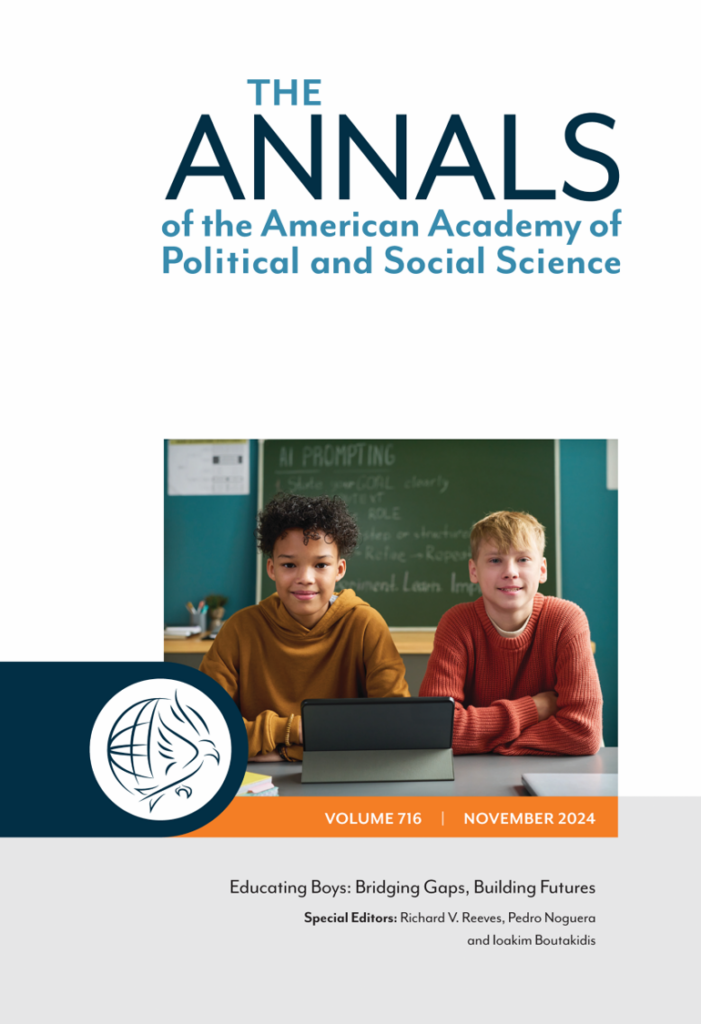
Turning to solutions, other scholars highlight the role of male teachers and mentors, and offer a vision of accountability systems that make gender gaps as visible as gaps by race and income. Hannah Kistler and Shaun Dougherty show that career and technical education can be a particularly powerful pathway for boys and young men, especially in improving engagement, completion, and labor-market outcomes. In other words, this volume is an early demonstration of what a concerted program of academic research into the education of boys and young men should look like. We are also delighted to include perspectives from two serving policymakers—Indiana’s Secretary of Education Katie Jenner and Linda Darling-Hammond, chair of the California State Board of Education.
Schools are not magical institutions. They cannot fix everything. But they are where almost every boy spends much of his childhood years, and they are where we can act without waiting for everything else to be fixed first. That is not a small thing. It is, in fact, exactly where we should start.
—Richard V. Reeves, coeditor of volume 716 of The ANNALS
