

This month’s Fellows’ Corner is written by sociologist and demographer Rogelio Sáenz, our 2023 Ernest W. Burgess Fellow.
If you are an AAPSS Fellow and would like to contribute to this column in future editions of the Dispatch, please contact Jessica Erfer.
The Latino Noncitizen Workforce Dwindles in the Trump Mass Deportation Era
Census Bureau population estimates now show that the US population growth rate between July 1, 2024, and July 1, 2025, was half of what it was in the previous year. The slowdown has been due principally to a significant reduction in the volume of net international migration (in-migrants minus out-migrants). Of particular note, the US added nearly one million fewer Latinos to its population in 2024–2025 compared to the previous year. Mass deportation under President Trump has certainly slowed population growth, but the most recent population estimates capture only a short period (January 20 to July 1, 2025) of the deportation campaign and lag by a year (the first set of 2024–2025 population estimates were released in January 2026).
Fortunately for demographers and others interested in tracking the labor force in greater detail, data from the Current Population Survey (CPS) are released monthly and provide a more up-to-date and detailed portrait of what is going on in the Latino workforce. I focus below on the change in the number of employed Latinos between February–July 2024 and February–July 2026 (before the mass deportation operation began and a bit more than one year after the start of the operation, respectively) for US-born, naturalized-citizen, and noncitizen Latinos.

Rising Latino Citizen and Declining Noncitizen Workforce, Especially Among Men
Across the two-year period, the overall number of Latino noncitizen workers fell by 936,000 (a 10% drop), with men accounting for nearly all (94%) of that decline. This decline of 881,000 Latino men workers (a 14.3% decline) compares to a decline of approximately 55,000 women workers (a 1.6% decline).1 Over the same period, the US-born Latino workforce rose by 2.7 million (a 17% increase) and the workforce of Latino naturalized citizens increased by 589,000 (an 11% rise).
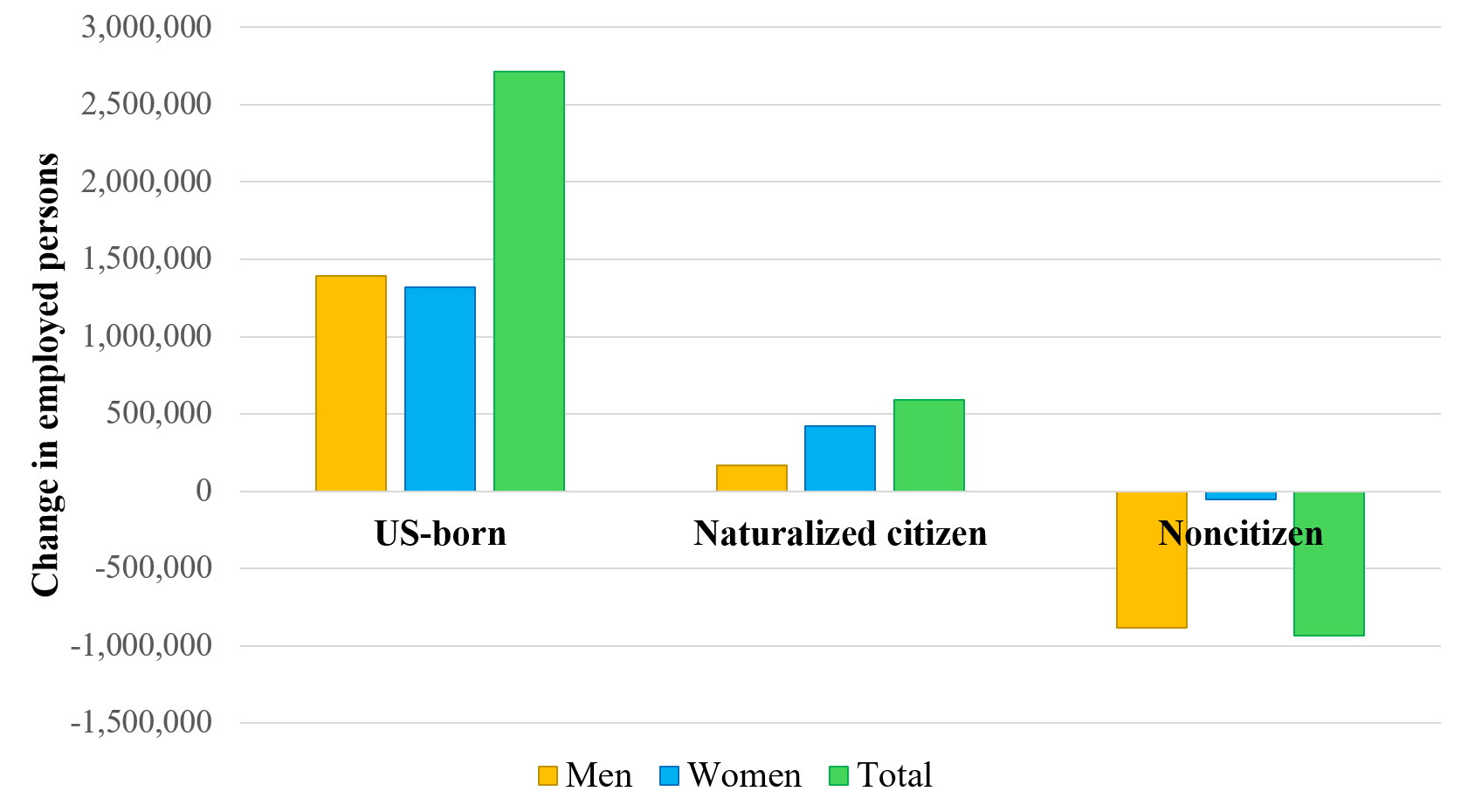
Why is the job decline of noncitizens so much greater among men? There are two possible answers. First, based on analysis of CPS data from 2016 to 2026, men are more likely than women to be in the Latino noncitizen group, which is 62 percent men and 38 percent women. Moreover, among Latino immigrants, women have a higher naturalization rate (55%) compared to men (46%). As such, it may be that among noncitizens, women are more likely to be permanent residents compared to men. Second, in general, noncitizen men are more likely than women to work in industries with greater public visibility, thus running a greater risk than women of being targeted by Immigration and Customs Enforcement. Indeed, in February–July 2024, roughly 54 percent of Latino noncitizen men worked in construction, restaurants, and landscaping, industries where workers are commonly visible to the public. In contrast, just 20 percent of Latina noncitizen women worked in these industries.
Decline of Latino Noncitizen Men Workers Concentrated in Three Industries
Latino noncitizen men experienced a reduction of nearly 647,000 workers overall: 358,000 in construction (a 16% decline), 172,000 in restaurant and other food services (a 27% decline), and 116,000 in the landscaping services industry (a 26% decline) between February–July 2024 and February–July 2026. These three industries accounted for 73 percent of the 881,000-person decline in the Latino noncitizen men workforce over this period.
Within occupations (i.e., the jobs that people hold, as opposed to the industries where those jobs are performed), there was a decline of more than 25,000 Latino noncitizen men workers in 14 occupations, with construction laborers (-140,946), landscaping and groundskeeping workers (-116,726), cooks (-90,731), carpenters (-78,428), and plumbers, pipefitters, and steamfitters (-70,088) at the top of the list.
| Occupational Category | 2024–2026 Change in Workforce |
|---|---|
| Construction laborers | -140,946 |
| Landscaping and groundskeeping workers | -116,726 |
| Cooks | -90,731 |
| Carpenters | -78,428 |
| Plumbers, pipefitters, and steamfitters | -70,088 |
| Other production workers | -49,954 |
| Painters and paperhangers | -48,351 |
| Janitors and building cleaners | -47,000 |
| Dishwashers | -36,687 |
| Other assemblers and fabricators | -35,138 |
| Brickmasons, blockmasons, and stonemasons | -32,288 |
| Waiters and waitresses | -31,122 |
| Welding, soldering, and brazing workers | -29,754 |
| Retail salespersons | -29,096 |
Latino Job Loss Clustered in 14 States
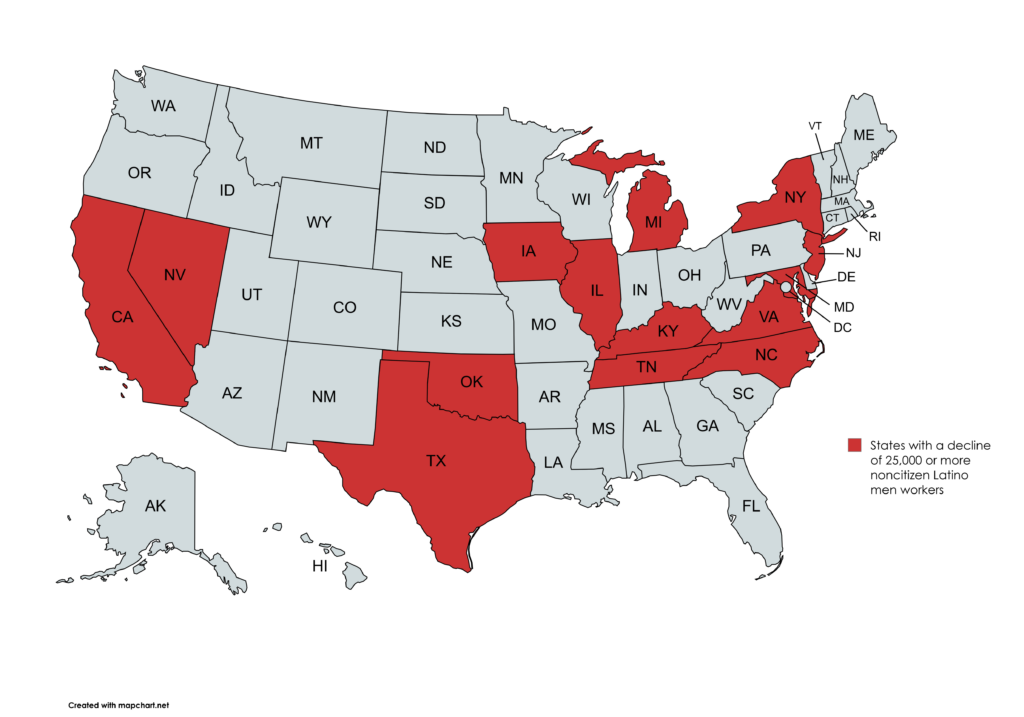
Fourteen states sustained declines of 25,000 or more Latino noncitizen workers, including both men and women, between February–July 2024 and February–July 2026. The largest declines occurred in California (306,000), Texas (262,000), North Carolina (172,000), New York (121,000), and Illinois (91,000). The most rapid declines in the Latino noncitizen workforce occurred in North Carolina (-47.6%), Michigan (-47.2%), Kentucky (-43.6%), Iowa (-39.0%), and Oklahoma (-35.7%). Thus, a broad array of states, including blue and red ones, have experienced major reductions in the Latino noncitizen workforce.
Conclusions and Significance
The Trump administration’s mass deportation campaign has disproportionately impacted Latino noncitizen men, with about one in seven no longer part of the workforce over the last two years. The repercussions of this job decline will be felt across the country’s economy, particularly in the sectors that have been most heavily hit. Job loss potentially worsens rising consumer prices, including rising food and gasoline prices, and the shortage of affordable housing. Of course, the significant decline of immigrant labor exacerbates challenges associated with an aging population, a projected decline in the workforce aged 16 to 29 by 2030, and financial strain meeting the costs of an expanding population of Social Security recipients.
—Rogelio Sáenz, 2023 Ernest W. Burgess Fellow
- The noncitizen population is highly diverse and includes not only unauthorized immigrants, the principal target of the mass deportation operation, but also permanent residents, international students, and others who are here legally. In addition, it is likely that an unknown portion of noncitizens may still be employed but are not participating in the Bureau of Labor Statistics (BLS) survey. ↩︎
The author thanks Stacy Liu and Tom Kecskemethy for editorial suggestions.