
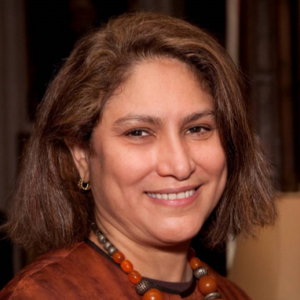
Social psychologist Mahzarin Banaji studies disparities between conscious and implicit expressions of attitudes and beliefs. She is perhaps best known for developing the concept of implicit bias (or implicit stereotype) with Anthony Greenwald; the two then developed the implicit-association test (IAT), which assesses stereotypes and behaviors that subjects may or may not be aware they hold. Banaji also studies the implication and application of her work, including how the science of implicit cognition can help improve individual decisions and organizational policies. Her current research interests include the origins of social cognition and the social and cognitive signatures of early large language models.
Professional positions
- 2002–present: Carol K. Pforzheimer Professor (2002–2008), Harvard College Professor (2014–2019), and Richard Clark Cabot Professor of Social Ethics (2002–present), Harvard University
- 1986–2001: Assistant professor (1986–1992), associate professor (1992–1997), full professor (1997–2001), and Reuben Post Halleck Professor (2001) of Psychology, Yale University
Notable publications
- Banaji, Mahzarin R., and Anthony G. Greenwald. 2013. Blind Spot: Hidden Biases of Good People. Delacorte Press.
- Greenwald, Anthony G., Mahzarin R. Banaji, Laurie A. Rudman, Shelly D. Farnham, Brian A. Nosek, and Deborah S. Mellott. 2002. “A Unified Theory of Implicit Attitudes, Stereotypes, Self-Esteem, and Self-Concept.” Psychological Review 109 (1): 3–25.
- Greenwald, Anthony G., and Mahzarin R. Banaji. 1995. “Implicit Social Cognition: Attitudes, Self-Esteem, and Stereotypes.” Psychological Review 102 (1): 4–27.
- Banaji, Mahzarin R., and Robert G. Crowder. 1989. “The Bankruptcy of Everyday Memory.” American Psychologist 44 (9): 1185–1193.
Degrees
- PhD, psychology, Ohio State University
- MA, psychology, Ohio State University
- MA, general psychology, Osmania University
- BA; English, philosophy, and psychology; Nizam College